
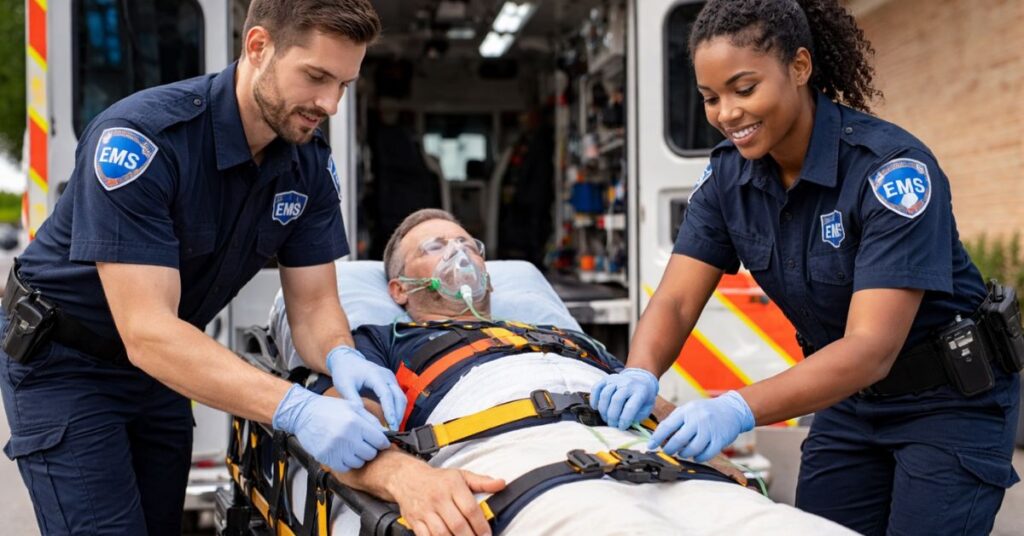

The National Registry of Emergency Medical Technicians updated its certification examination in April 2025, introducing new question types and a revised domain structure. If you are preparing for the NREMT, studying for the old exam format could actively hurt you. Here is what changed and how to get ready.
If you are working toward your EMT certification in 2025 or 2026, the exam you are preparing for is different from the one your instructors may have taken. The National Registry of Emergency Medical Technicians (NREMT) launched an updated version of both the EMR and EMT Certification Examinations on April 7, 2025 — a significant revision that changed the question formats, the domain structure, and the balance of content across the exam.
For anyone heading into the EMS field, passing the NREMT is non-negotiable. It is the national standard for EMT competency, accepted across the vast majority of US states as part of the licensing process. And with a first-sitting pass rate of roughly 70 per cent at the EMT level, it is not a test where underpreparation is forgiven.
What Changed in the 2025 NREMT Update
According to the National Registry of Emergency Medical Technicians, the April 2025 update introduced Technology Enhanced Items (TEIs) that now count toward a candidate’s score. These include drag-and-drop questions, option-box selections, and build-a-list questions — formats that were previously used only as unscored pilot items. Candidates who have been preparing exclusively with multiple-choice practice resources will encounter these question types on exam day if they are not prepared for them.
The domain structure of the EMT exam also changed. The previous format had five traditional content categories. The updated exam reorganises content around five revised domains with a significantly heavier focus on patient assessment — specifically on critical thinking, pathophysiology-based assessment, and differential diagnosis. Clinical judgment scenarios were deliberately excluded from the EMT level (they appear on the paramedic exam), keeping the EMT assessment focused on core entry-level competencies.
How the Computer-Adaptive Format Works
The NREMT is a Computer Adaptive Test (CAT), which means your exam experience will be different from every other candidate’s. The algorithm begins by selecting questions at or near the entry-level standard. As you answer correctly, it serves harder questions. As you struggle, it adjusts. The test ends when the algorithm can determine with 95 per cent confidence whether you have demonstrated entry-level competency — or when you hit the maximum question count.
For the EMT exam, candidates receive between 70 and 120 questions with a two-hour time limit. A passing score of 950 (on a scale of 100 to 1,500) is required. Candidates have six attempts to pass, with a 15-day waiting period between attempts. After three failed attempts, remedial education is required before a fourth try.
“The CAT format means you cannot pace yourself by the number of questions remaining or use the number of questions you have answered to infer how you are doing. Every candidate gets a different test. The only reliable strategy is to know the material.”
Given the CAT structure and the introduction of new item types in 2025, preparation quality matters more than preparation volume. Candidates who drill with realistic, current-format practice questions — using up-to-date NREMT practice test resources that reflect the revised domain structure — will be more prepared for the actual exam experience than those who grind through outdated multiple-choice question banks.
What the NREMT Tests Across Each Domain
The five domains of the updated EMT examination cover Scene Size-up and Safety, Primary Assessment, Secondary Assessment, Patient Treatment and Transport, and Operations. The exam draws from a comprehensive content outline derived from a 2023 practice analysis that examined the real-world tasks EMTs perform in the field. This means the questions are grounded in actual EMS work rather than purely theoretical scenarios.
Key clinical areas tested include airway management, bleeding control, patient assessment across medical and trauma presentations, cardiovascular emergencies, respiratory emergencies, altered mental status, and mass casualty event management. For candidates with a strong healthcare or fitness background, many of these topics will be familiar — but the NREMT tests them at the level of applied clinical decision-making, not just definition recall.
Application Fees and Recertification
The application fee for the EMT Certification Examination is $104, submitted online through the National Registry’s candidate portal before an Authorisation to Test (ATT) letter is issued. Once certified, EMTs must recertify every two years — either by completing 40 continuing education credits through the National Continued Competency Programme or by retaking the cognitive examination. Starting April 2025, the new NCCP model applies to all EMT and AEMT recertification cycles.