
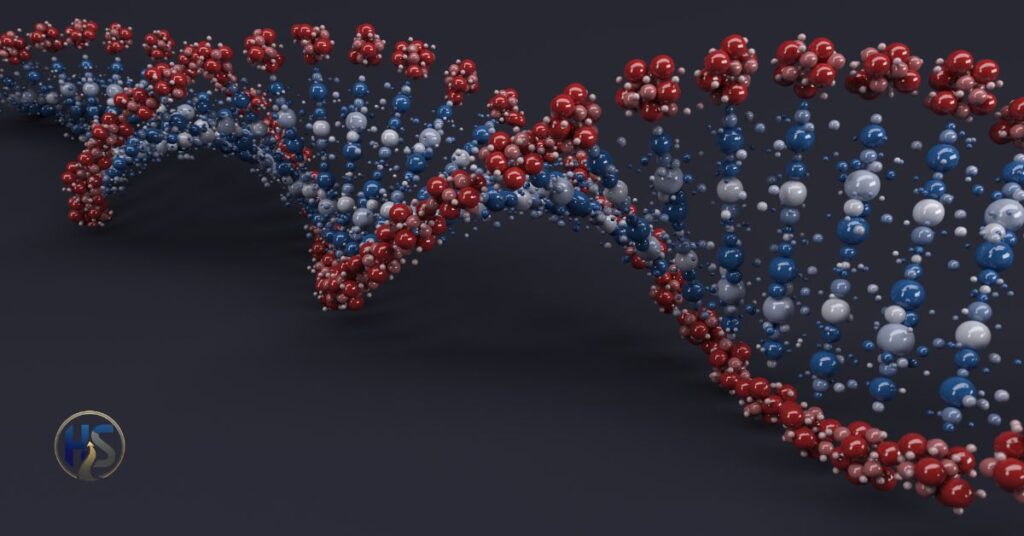

Nucleotides are the biochemical units that make life possible. They store genetic information, power cellular metabolism, regulate signaling networks, and serve as the foundation of modern molecular medicine. Every cell division, muscle contraction, neural impulse, and immune response depends on nucleotide chemistry. Their biological influence spans from molecular evolution to gene editing technologies.
This guide provides a complete, research-level synthesis of nucleotide biology, metabolism, disease relevance, and biomedical applications.
Biochemical Definition and Molecular Architecture
A nucleotide is composed of three components:
- A nitrogenous base
- A pentose sugar (ribose or deoxyribose)
- One to three phosphate groups
The sugar and base form a nucleoside. Addition of phosphate creates a nucleotide. Phosphate groups attach at the 5′ carbon of the sugar, enabling polymerization via 3′–5′ phosphodiester bonds.
This directional linkage creates nucleic acid strands with polarity (5′ → 3′ orientation), a fundamental property required for replication and transcription fidelity.
Even slight structural modifications—such as removal of the 2′-OH group in deoxyribose—dramatically increase molecular stability. This explains why DNA is suited for long-term information storage, while RNA is more reactive and regulatory.
Nitrogenous Bases: Structural Chemistry and Pairing Fidelity
Nitrogenous bases determine information encoding and molecular recognition.
Purines (Double Ring Structure)
- Adenine (A)
- Guanine (G)
Pyrimidines (Single Ring Structure)
- Cytosine (C)
- Thymine (T)
- Uracil (U)
In DNA:
- A pairs with T (2 hydrogen bonds)
- G pairs with C (3 hydrogen bonds)
The triple hydrogen bonding between G and C increases thermal stability. Genomic regions rich in GC content have higher melting temperatures, influencing replication and transcription dynamics.
DNA polymerase replication fidelity is extraordinarily high—error rates are approximately 1 in 10⁹–10¹⁰ nucleotides after proofreading. This precision depends entirely on correct base pairing.
Polymer Formation and DNA/RNA Structural Stability
Nucleotides polymerize into polynucleotide chains. The sugar-phosphate backbone forms the structural scaffold, while bases project inward to encode information.
DNA forms a double helix stabilized by:
- Hydrogen bonding
- Base stacking interactions
- Electrostatic stabilization
RNA is usually single-stranded but folds into complex secondary structures (hairpins, loops, pseudoknots), allowing catalytic and regulatory functions.
Structural variation enables biological diversity without altering chemical fundamentals.
Nucleotides as Energy Molecules: ATP Turnover and Bioenergetics
Adenosine triphosphate (ATP) is the central energy carrier of the cell.
Key quantitative insight:
- Hydrolysis of ATP → ADP releases ~30.5 kJ/mol under standard conditions.
- A resting human turns over approximately their entire body weight in ATP daily.
ATP powers:
- Ion gradients (Na⁺/K⁺ pumps)
- Muscle contraction (myosin cycling)
- Biosynthesis
- Vesicle trafficking
Other nucleoside triphosphates:
- GTP drives translation and microtubule dynamics.
- CTP participates in phospholipid synthesis.
- UTP supports glycogen metabolism.
Energy metabolism is fundamentally nucleotide metabolism.
Cell Signaling and Regulatory Networks
Nucleotides act as intracellular messengers.
Cyclic AMP (cAMP):
- Activates protein kinase A
- Regulates glucose metabolism
- Modulates gene transcription
Cyclic GMP (cGMP):
- Regulates vascular tone
- Involved in phototransduction
Nucleotide-derived cofactors:
- NAD⁺ and FAD function in mitochondrial oxidative phosphorylation.
- NAD⁺ levels influence aging-related pathways and sirtuin activity.
Thus, nucleotides coordinate metabolism, gene regulation, and cellular adaptation.
Nucleotide Metabolism: De Novo and Salvage Pathways
Cells synthesize nucleotides via:
De Novo Synthesis
Constructs bases from:
- Amino acids (glycine, glutamine, aspartate)
- CO₂
- Ribose-5-phosphate
Purine synthesis consumes significant ATP, making it energetically expensive.
Salvage Pathway
Recycles free bases using enzymes such as:
- HGPRT (hypoxanthine-guanine phosphoribosyltransferase)
Defects in salvage enzymes can cause severe metabolic disorders.
Balanced nucleotide pools are essential. Imbalance increases mutation rates and genomic instability.
Nucleotide Dysregulation and Disease Mechanisms
Abnormal nucleotide metabolism contributes to disease.
Gout
Excess purine breakdown increases uric acid, leading to crystal deposition in joints.
Cancer
Rapidly dividing cancer cells upregulate nucleotide synthesis pathways. Many chemotherapeutics target enzymes like thymidylate synthase to disrupt DNA synthesis.
Genetic Disorders
Deficiencies in nucleotide metabolism enzymes can impair immune function and neurological development.
Because DNA replication depends on precise nucleotide ratios, imbalance can cause replication stress and mutation accumulation.
Nucleotides and the Immune System
Immune activation requires massive nucleotide synthesis for clonal expansion of lymphocytes.
High-demand conditions:
- Infection
- Tissue injury
- Chronic inflammation
Nucleotide availability influences:
- Antibody production
- Cytokine signaling
- T-cell proliferation
Rapidly dividing immune cells are particularly sensitive to disruptions in nucleotide pools.
Gut Health and Tissue Regeneration
The gastrointestinal epithelium is one of the most rapidly renewing tissues in the human body, with cellular turnover occurring approximately every three to five days. This intense regenerative demand requires continuous DNA replication and RNA synthesis, processes fundamentally dependent on nucleotide availability. Adequate nucleotide pools support epithelial repair, maintain tight junction integrity, and reinforce mucosal barrier function. During inflammation, infection, or metabolic stress, nucleotide demand increases substantially. Efficient synthesis and salvage pathways therefore play a decisive role in preserving intestinal resilience and promoting optimal tissue regeneration.
Nucleotide Analogues in Medicine
Synthetic nucleotide analogues revolutionized medicine.
Antiviral therapies:
- Incorporate faulty nucleotides into viral DNA/RNA, halting replication.
Cancer therapies:
- Inhibit nucleotide synthesis enzymes.
- Disrupt DNA replication in tumor cells.
mRNA-based therapeutics:
- Use modified nucleotides to improve stability and reduce immune overactivation.
Modern precision medicine depends on nucleotide chemistry.
Evolutionary Perspective: Origin of Nucleotides
From an evolutionary standpoint, nucleotides are believed to have emerged under prebiotic Earth conditions, forming the biochemical foundation for early self-replicating systems. The RNA world hypothesis proposes that ribonucleotides preceded DNA and proteins, functioning both as information carriers and catalytic molecules. Ribozymes—RNA molecules capable of enzymatic activity—demonstrate this dual capacity. The transition from RNA-based systems to DNA-protein biology reflects a progression toward increased stability and specialization. This evolutionary continuity underscores the central role of nucleotides in the origin, diversification, and persistence of life on Earth.
Synthetic Biology and Gene Editing
CRISPR gene editing relies on nucleotide-guided RNA sequences to target specific DNA regions.
DNA sequencing decodes billions of nucleotides to identify mutations.
Synthetic genomes are built nucleotide by nucleotide.
Modern biotechnology operates at the nucleotide level.
Mitochondrial Nucleotide Pools and Aging
Mitochondria maintain independent nucleotide pools for their DNA replication.
Decline in NAD⁺ levels has been associated with:
- Reduced mitochondrial efficiency
- Altered metabolic signaling
- Age-related cellular decline
Maintaining nucleotide balance is increasingly studied in longevity research.
Conclusion
Nucleotides represent the ultimate molecular currency of biological systems. They store genetic information with extraordinary precision, drive cellular energy transfer through ATP hydrolysis, regulate metabolic and signaling networks, and sustain replication fidelity across generations. Every biochemical transaction inside a living cell—whether it involves gene expression, membrane transport, or immune activation—depends on controlled nucleotide availability and balance. Their structural elegance and functional versatility position them at the core of molecular biology, medicine, and biotechnology. To understand nucleotides is to understand the operational logic of life itself.
FAQ
Q. Why are nucleotides essential for life?
Because they store genetic information, power metabolism, and regulate cellular signaling.
Q. How many ATP molecules does a human use daily?
An adult synthesizes and consumes roughly their body weight in ATP each day.
Q. What happens if nucleotide balance is disrupted?
Imbalance can cause genomic instability, immune dysfunction, or proliferative disorders.
Q. Are nucleotides involved in aging?
Yes. Molecules like NAD⁺ influence metabolic regulation and age-related cellular processes.
Q. Why are nucleotide analogues used in medicine?
They interfere with replication in viruses and cancer cells, making them powerful therapeutic agents.